Showing posts with label floral design. Show all posts

Thursday, June 5, 2014

Bay Area Visit 2014: FLORA GRUBB

If there's a name that's stood out in the last few years in terms of innovative garden trends, Flora Grubb is probably on top my list.


A few years ago, I remember sitting down for lunch with a landscape architect friend who was starting up his own design-build business and told me about a vertical garden project he was working on utilizing succulents. Part of me sort of rolled my eyes as I began to see EVERYONE growing succulents and purchasing all these new (and expensive!) products like Wooly Pockets ( felt-like bags filled with soil and plants that can hang along a railing or placed up against a wall). The early plantings I saw in garden centers were very ugly as if people simply just shoved whatever plant they were told could grow in them.


Then I began to notice garden centers carrying more air plants (Tillandsias). Next to them were these glass orbs (some hanging on a fishing line) with a large hole in them and inside was a Tillandsia and a piece of moss or lichen and a few twigs. These were dubbed as "Aeriums" like "Terrarium", but without the "terra" or "earth" part of it. I thought they were kind of neat, but seemed to be somewhat of a temporary composition as air plants can be somewhat finicky in the home if they don't get enough warmth and humidity, but enclosing them in a terrarium-like glass vessel was suppose to just do the trick!

So, during our chat, we discussed our businesses and he introduced me to the name Flora Grubb as a model of success in our line of work and that in order to thrive as a landscape business, we had to really find a need in the market and really push for that ever illusive "niche". Being somewhat reluctant to follow any sort of trend while simply focusing on the work I had before me, the name just kept coming up as I chat with fellow gardeners and designers.

The name is actually the name of a very talented and innovative young woman who teamed up with a business partner, Saul Nadler, to first start a palm nursery and they decided to take her name and start a venture that would change the course of how people looked at plants in their lives.

So, there's a floral design component to this blog post as well. Susie Nadler, Saul's wife, runs the floral component of Flora Grubb and, once again, the clever and beautiful use of succulents and Tillandsia are evident and actually inspired my design work quite a bit.

Michelle's wedding featuring Tillandsias in a really sophisticated bouquet inspired by Susie's work!


After all the hoopla and press I've heard about this business venture, I truly wanted to experience the phenomenon that is Flora Grubb for myself and MAYBE meet her in person to better understand the model she has created and, perhaps, discover elements of her business structure that attracts the next generation of gardeners.


Here are some highlights from my visit this past April:


A popular destination in an industrial part of San Francisco, Flora Grubb provides an oasis for city dwellers to relax and take in a bit of nature

Ideas and inspiration can be found everywhere you turn

Amazing what can be accomplished in such a small space. It feels huge!

Rotating displays of plants and containers keep things looking fresh and the wide paths invite you to explore

F L O R A spelled out in succulents!

"Rustic chic" with a living centerpiece....


...of succulents!

A colorful and modern sitting area

...with the best succulent wall I've ever seen!

Flora Grubb has DIY benches for customers to pot up containers and create aeriums! Love this idea!


The wonderful Tillandsia selection. I had a chance to meet Zenaida Sengo who works for FG and also has a book coming up on air plants!


Tillandsia concolor looking stunning up against a purple panel!


FG has everything an urban gardener needs! Even old bicycles for floating!


Now this is how you plant up those Wooly Pockets! Make it look like it's been growing there forever!


It's not all just succulents and air plants. Perennials, trees and shrubs and edibles can be found!


Todd Holloway of Pot Inc. in Vancouver, BC introduced these hover dishes this year and are perfect for succulents

 Overall impression of the place? Pretty cool!

I think Flora Grubb satisfies a pretty broad customer base that's really geared to be simple, sophisticated, creative and most importantly, accessible. I often am critical of small "Boutiquey" shops that have very high mark-ups claiming a "work of art" for something so simple and straightforward, but that's coming from a experienced plant-person point of view who's also a tightwad when it comes to things that are considered "luxury items". I was a bit sticker-shocked at some of the prices on materials that were simply "sanded down twigs for $25), but that's retail for you; they understand that there are those who are more than willing to pay for such items.

The space and layout is the best part of Flora Grubb. Wonderful plants all around, but there are distinct garden rooms and places to sit and really be immersed in the vegetated space.

Knowing Flora is probably near impossible to track down for a chat given the celebrity status a lot of us have given her, I got in touch with their PR and also palm specialist (AGAIN, WITH A BOOK IN THE WORKS ON THE TOPIC!), Jason Dewees, who kindly set up a short meet and greet and took this picture!


Being on a tight schedule, I was bummed not to get a sit-down interview with her to ask about her design aesthetic, business model and what she foresees as the future of gardening, but I sort of let that go. Part of me felt like she's been asked this a million times and I didn't come prepared with more interesting insights and inquiries. She also didn't have much time so, I thought, I just need the experience of just being there, making my own observations and this meet and green was just an icing on the cake! 

Then I began to wonder if a model like Flora's could exist here in Seattle. It sort of does, in a way, with a few businesses deriving elements of her set up and offering products similar to hers, but one has to consider location and also the CLIMATE! They're blessed with a true Mediterranean climate so the plant palette is quite different, but the overall goals are the same: make plants and gardening accessible at many different levels and offer a space for refuge, relaxation and ongoing inspiration. Also a place where visitors can be engaged by being able to create for themselves instills confidence in growing! I loved that aspect of Flora Grubb.

What was also impressive was the number of staff on hand tending the plants and helping customers. Flora has hired experts with specialties, like Jason and Zenaida, to be on hand and not only do they have their fortes, they are also multi-talented individuals with a broad range of stills they bring to the table! That was mighty impressive because even the uber plant geeks like myself can feel engaged at Flora Grubb!

I hope to return in the near future to see how things are evolving and see what new and inspired ideas emerge because I'm certain it will be executed beautifully!


R


Sunday, May 25, 2014

Bay Area Visit 2014: San Francisco Wholesale Flower Mart

What's becoming almost an annual trip down to the Bay Area to visit friends, family, nurseries, and gardens, I had three destinations in mind for my extended weekend down in the Bay Area of California. One of my first stops was one of the country's largest flower markets!

"If you're going to San Francisco, be sure to wear some flowers in your hair".... well, then you have to hit up the famous SF Wholesale Flower Mart on Brannan Street.

Composed of a MASSIVE warehouse where 60+ vendors pack the large facility with cut blooms, potted plants, branches, and other natural materials, the SFWFM also includes "stores" lined up one by one selling specialty products such as orchids, potted tropicals, floral supplies and other hard goods. It's the nucleus of the Bay Area's floral industry and you can basically get everything you need to run your flower business.
It was a little intimidating to go as I was renting a car for the very first time so driving into the big city was a little nerve-wracking (thank goodness for iPhone Maps)  and I was also testing out my new digital camera and entering a place that can be very fast paced and I was actually worried about vendors harping on me for being a disturbance. Perhaps I could have contacted someone and inquired about visiting and taking photos, but they did have public shopping hours so I thought I'd just go and ask the individual vendors if I could take photographs and all seem to say "yes" (although I did see a sign that said "no photography please", but no one said anything and I was pretty much finished taking photos when I saw it. OOPS.

This place was quite large and pretty exciting to see the product being offered.


These manzanita branches were to die for!

California grown!!


A baker's multiple dozens of already cut succulents!
 
Yes, please!!!!!!!!!!!!!!!!

An assortment of Bromeliads sold here for floral work!
 

My favorite Tillandsia xerographica


Puffy hydrangeas including some unusual peachy types!

A close-up of these soft peach Hydrangeas that were probably dyed. =(


A most interesting manipulation of Phalaenopsis orchid spikes shaped into a heart

Fresh old-fashioned garden roses!!


 Another interesting observation was a business that I've heard a lot about in various publications. "Farmgirl Flowers" is tucked into a vendor stall within the SFWFM and boy is business thriving for them. What surprised me most were the multiple employees. Two long tables up front are flanked with Macs with 5-6 people at a table probably taking orders and in the background you can see all of their supplies and the arrangements being assembled. They supply locally sourced flowers throughout the city and often do special events.


 Their wedding inquiries are sent over to my next stop in San Francisco: the infamous FLORA GRUBB.

 ----------------------------------------------------------

For more information about the market, visit their website (which could use a reformat and update):


R

Monday, March 24, 2014

Winter Hellebores as cut flowers and how to make them last

A plate of hellebores from Northwest Garden Nursery
March is peak Hellebore season for us in the Pacific Northwest and there's so much to love about them in the garden, but the temptation is ALWAYS there to cut them to bring inside for a vase. The trouble is, once hellebores are cut, they often have a hard time actually taking up water and in a matter of minutes, their heads are drooping and look unflattering. So to enjoy them, most people will just float them in a shallow platter like the O'brynes did above.


First, I want to write about the different types of hellebores one would encounter at a large garden center. There are two main types that are distinguished by their growth habit:  stemmed (caulescent) or stemless (acaulescent).


Caulescent types emerge from the ground and have a prominent stem with attached alternating leaves and the clusters of flowers up top. H. argutifolius is an example (the green ones in the photo on the right and all the foliage you see is attached to the main stem with the flowers up top)


Acaulescent hellebores do not form a stem with foliage, but instead, all the foliage and flowering stems emerge from the base of the plant. The "orientalis" type of hellebores are the most common. (the pink flowered ones on the photo)


Now, between the two basic growth habits, there are hybrids between the two types creating varieties that possess some of the qualities of both resulting in vigorous and hardy garden plants.

Helleborus x ballardiae 'Pink Frost'

I've found that all types of hellebores have a difficult time standing up when cut for a vase. There are many tricks that have proven to be effective such as:

1. Dip cut ends in hot boiling water for a few seconds.

2. Flame the cut ends for a few seconds to supposedly "seal in" the moisture

3. Slice bottom end lengthwise an inch or so to maximize water uptake. (Mentioned by Val Easton on her blog. She wrote a book called "Petal & Twig")

4. The age of the flowers play a very important role in the longevity of a cut hellebore. Wait until the ovary begins to develop when the stamens, anthers and nectaries have fallen off and the flowers are a little "greener" and they'll last for about 10 days when cut (according to Diane Szukovathy of Jelly Mold Farm)

I've primarily been playing with the "Orientalis" types (very uncommon to get the true Helleborus orientalis species). They are botanically referred to as Helleborus x hybridus because they're far more plentiful in bloom along with some of the complex hybrids out there like 'Pink Frost' above, 'Merlin', and 'Cinnamon Snow'.

So recently, I chatted with Linda Beutler at the Yard, Garden, and Patio Show in Portland, Oregon who wrote the book, "Garden to Vase: Growing and Using your Own Cut Flowers."

 
Linda advised me to try the following solution to condition Hellebores for arranging:

2 tablespoons of alcohol to 1 quart of regular tap water 
1 packet of flower food (optional)

Keep Hellebores in a cool location as they soak up this solution overnight (I never found out how long, this is how long I soaked mine, but it's probably less than that) and then they'll be ready for arranging.


So, I used a combination to maximize the longevity of these precious cut blooms (and also to tell each of the people I've consulted about hellebores that their technique worked! LOL!)


I've noticed that Hellebores need to be kept cool and hydrated as if they've never been cut. So, I bring a bucket of water out to the garden that will have at least half of the cut stems submerged.

As I select stems to cut, Linda recommended that one should wait until the very first bloom to mature (meaning having the stamen, anthers, and nectaries naturally fall off). Diane will wait for all flowers to loose their central bits. 

Then I used Linda's solution to condition the flowers and remarkably, they stayed perky and held up pretty well for 2-3 days inside the house. Then I noticed a few things:

1. A few wilted sooner than others.
2. Re-cutting the stems seems to "uncondition" them.
3. The shorter the stems (mostly submerged in the water, the longer they seemed to hold up. 


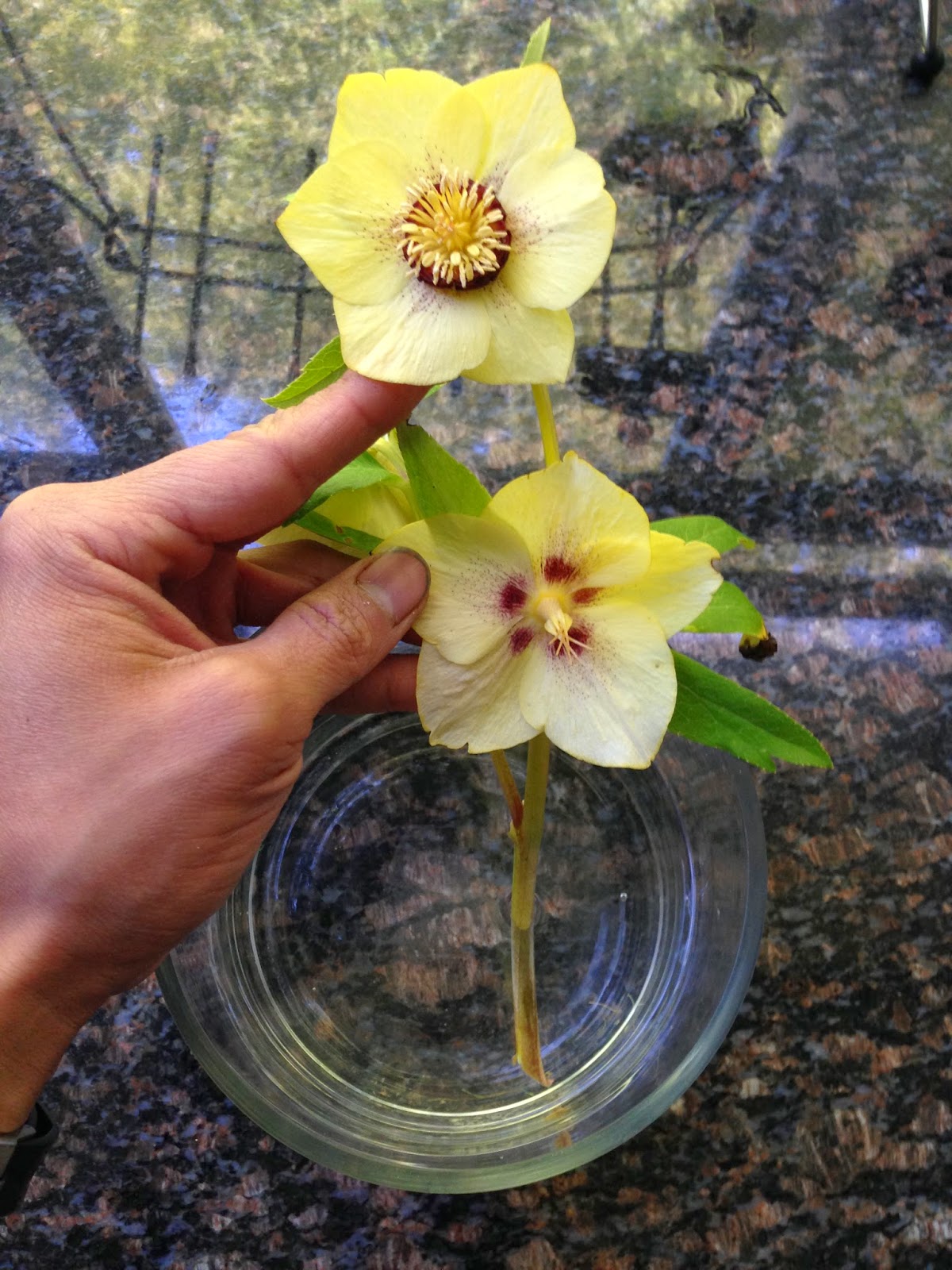
A bright and gorgeous Golden Sunrise hellebore just cut from the garden. Noticed the first flower to open and mature at the bottom.

Split the cut end to maximize water uptake

Immediately submerge in fresh water or in a conditioning solution.

CONCLUSION:  This alcohol solution seems to work and is simple, cheap and highly effective if flowers are harvested at the right stage. 

*2 tablespoons of alcohol to 1 quart of water and a packet of flower food if you have it.

*Always keep them as cool as possible (again as if they weren't disturbed by being cut) and the shorter the stems, the better.

*The "green" varieties seem to hold up much better than the others.

And no, I'm no afraid of heat or fire, I just haven't gone that route because I have an issue of physically damaging plant tissue when it might not be necessary.


Debra Prinzing, author of "Slow Flowers", with split-stemmed, alcohol/flower food conditioned hellebores from UW Botanic Gardens/Washington Park Arboretum she took with her on a plane to New York to help promote American grown flowers for a very special wedding! They held up VERY WELL and designers drooled and fought for them!


Can you spot the hellebores??  Arrangement lasted about a week in a cool room indoors and the Akebia vine opened is scented blooms!


A very tiny centerpiece with a "conditioned" hellebore that lasted only 1 day before it curled up. Maybe if I used an "older" bloom.


Pink hellebores with flowering currant (Ribes sanguineum). I kept this arrangement outside. Most of the conditioned Hellebores held up for about 5 days, but one variety in the foreground is still "plump" after about 9 days.


A very short arrangement using parrot tulips and the bloom head of H. argutifolius which did not hold up as an entire stem when conditioned and put into plain water inside the house. So I cut the flower head, conditioned the short stem in the alcohol before arranging this and they still look good after 8 days.


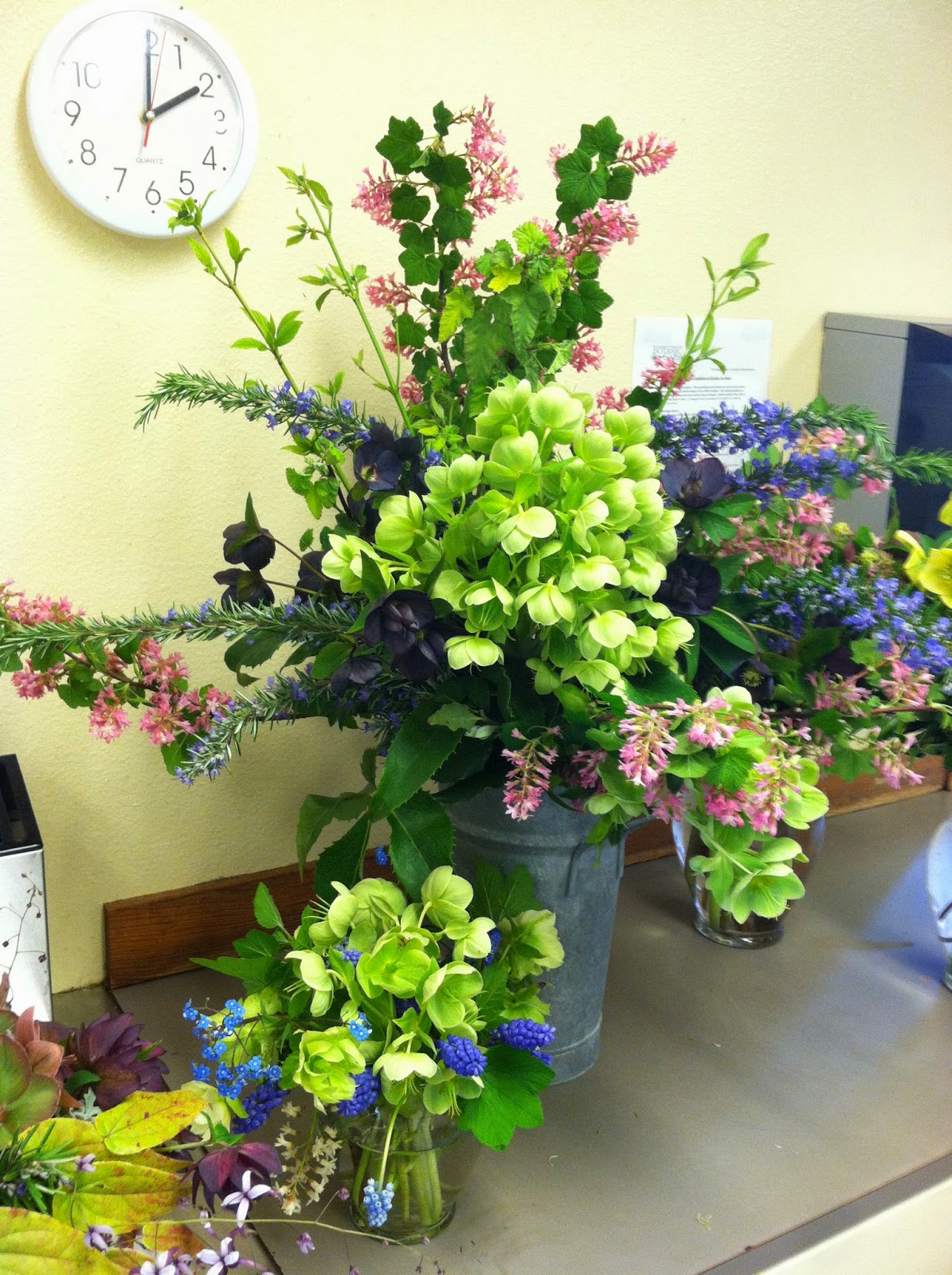
Again, shorter stems hold up longer and you can use lovely grape hyacinth with them!!


More hellebores and Muscari latifolium

Black hellebores with the silver/green cardoon foliage is stunning together with sprays of Osmanthus delavayi for fragrance

Older blossoms of 'Pink Frost' hold up well and much longer than the delicate Epimedium in the foreground
 

Green and chartreuse mean SPRING!!


"I'm ready...." it says...


Riz