Tuesday, November 16, 2010

Showing a little Husky Pride

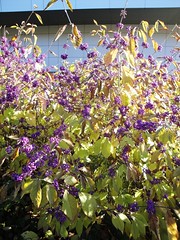
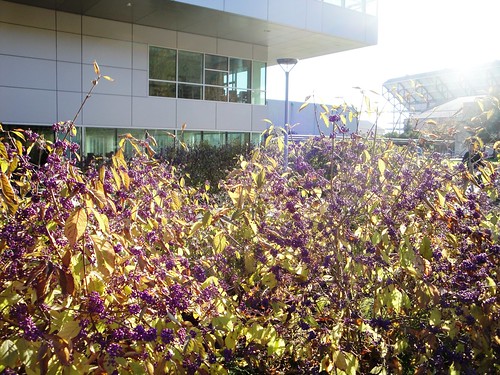
So, I work out at the UW's Intramural Activities Building (often dubbed as the "IMA") and each fall, I look forward to the new crop of young college hotties and the abundant fruit and fabulous color effect on a large scale planting of beautyberry!

IMA with Callicarpa


Whoever planned and designed this planting scheme is quite clever as very few plants can ever match a school's colors so effectively (in this case, purple and gold)!!

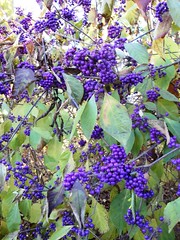
Callicarpa Profusion fall color DSC07106


This is Callicarpa bodinieri var. giraldii 'Profusion'
. Readily available and popular at nurseries at this time of year because of plantings such as this at the UW. They are easily grow in most well-drained soils in full sun or part shade and are perfectly hardy and suited for our area.

Sunday, November 14, 2010

The Best of 2010: Part 1: Knowing the Knotweeds

I'm becoming very fond of many selections of Persicaria that are out there. Their bold and often dramatically marked foliage are so eye-catching and the spikes of bright red are fun and add a nice surprised come summer. I find in kind of unfortunate that they're related and often mistaken for their close relatives Polygonum cuspidatum (Japanese Knotweed). The ornamental Persicaria (the most common being selections of P. amplexicaulis and P. virginiana), though known to also be quite aggressive and vigorous, are manageable and easy to maintain.
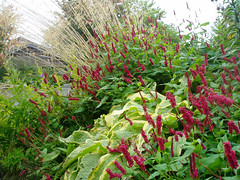
Soest Autumn 2007 Persicaria with Symphytum
Here's Persicaria amplexicaulis 'Taurus'. A fine border plant for full sun that forms dense, almost woody clumps of lush foliage and abundant spires of red flowers that form in early summer and after that first flush which ends in mid-summer, the plants are sheared back to the ground for a second round of fresh foliage and then MORE flowers that often last until frost! Mature plants can spread 4-6ft. wide and the flowering spikes rise up to about 2.5ft. They're wonderful fillers in flower arrangements!
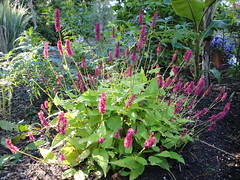

Persicaria Golden Arrow
A brand new and exciting selection (at least to me!) I've acquired this year is one that seems a bit tidier and a smaller version of the above, but with glowing chartreuse foliage. This one was dubbed 'Golden Arrow'. I purchased a division from my friends at Far Reaches Farm in Port Townsend, WA and I've been very pleased with it's habit. Now, it's only the first year and it's not really in the richest or moistest spot in the garden, but I see this as being a very attractive and useful plant in part to full shade, although it gets its best golden foliage in full sun.
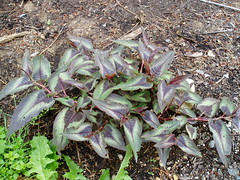

Persicaria Red Dragon
P. 'Red Dragon' is a selection of P. microcephala and TALK ABOUT FOLIAR APPEAL! As gorgeous as these leaves are, it is kind of a rambunctious plant, but the great foliage color and weaving habit and small clusters of white flowers late in the season make it a fun and welcomed addition in the garden. Should it get out of bounds, just whack it back to the ground and prepare for a nice flush of new foliage!
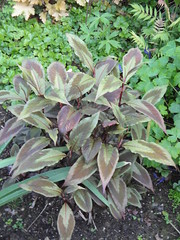


Persicaria Compton's Form
Here's one that we don't see too often, but it is quite striking. This one is referred to as 'Compton's Form'. The flowers on this aren't really that spectacular, but for foliage, it's quite dramatic. This photo shows off the early season color in full sun, but grown in shade, the leaves are bigger and you get this effect:
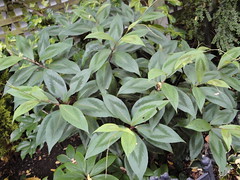
Persicaria Compton's Form 2


And finally, one I'm quite fond of, but not many local nurseries here carry it is this selection called 'Brushstrokes'. It's not as busy or overly dramatic in terms of color, but the painted "chevrons" and HUGE leaves are so bold and attractive.
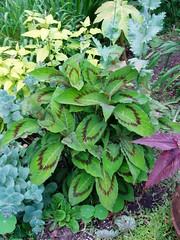
Tovara 'Brushstrokes'


There's way more out there that's available, but these are just some of my favorites in the garden this year!


R
Monday, November 1, 2010

Tree Alien!


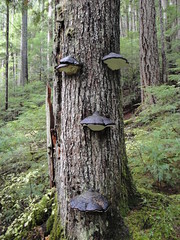
In a recent mushroom foray, we encountered this amusing set of artist's conks (Ganoderma applanatum) mushrooms on a Douglas fir that reminded me of a character on the animated series, "American Dad".
So, Roger, the drunken, drug-using, drag-dressing, dimwit of an alien, came to mind when I took this photo:


DSC06952 Roger


I have NO IDEA what he stuck in there! LOL!!


R

Tuesday, October 26, 2010

'True Blue', baby, I love you...

Yeah, yeah. I fell for it: Gentiana 'True Blue', baby, I love you. Now if you'll just winter over, grow and flower prolifically. Oh, and keep coming back each year better and better. lol

A hybrid Gentian bred and introduced by Epimedium authority Darrell Probst. The color is so captivating and ethereal, I couldn't help, but just get it for my garden.

I also couldn't help humming the Madonna tune from when I was a wee lad.

Now a flash back to the 80's:

Sunday, October 24, 2010

Fleeing the Nest

Ok, so it took 10 years, but I've moved out and found a different place to live. I do miss being able to step outside in the morning to work in the garden, having a coffee and breakfast outside as the early light illuminates my plants and all that sentimental stuff, but I needed this move.

Now, in a way, I feel like I can have a life like the rest of my peers and I can truly represent the "Next Generation"! haha.

Most common question I've gotten: "Do you have a yard to play with and plant?"

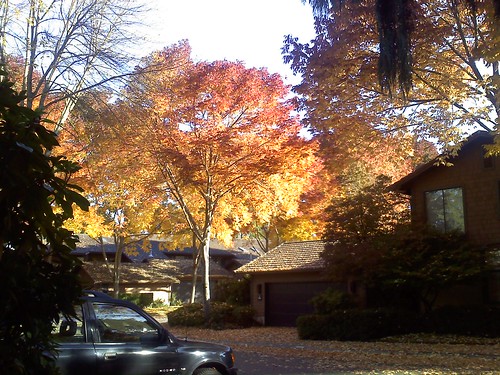
No. But it's a good thing! I'm living with a UW Professor introduced by a friend/former volunteer of mine and it's all been working out well. He owns a town home in North Seattle where a landscape company oversees the maintenance of all the grounds here. It's actually not bad and the fall color on the allée of ashes (Fraxinus sp. haven't properly ID'd them yet) is captivating! Looks like our complex is on FIRE!

Fall Color in Stendall Place


While I could take over and teach them a thing or two about pruning and plant selection for the foundation plantings, I really don't need to. In a way, it's sort of a temporary living situation and it doesn't make sense to create more work for myself. I'm glad not to be coming home to outdoor physical work.

Going up to the garden every other day seems to work out okay. I feel like I'm not as overwhelmed (cutting back on nursery stuff as well) and I'm able to set a time limit to be able to call it quits for the day because: 1) It's getting darker earlier now and 2)I have to actually GO HOME!

Knowing that I'll need to be growing something in close proximity, I've already told my housemate that I might pot up some containers and help him with his hanging baskets. I could also follow my own advice and get some houseplants going again, but it'll be a challenge as I'm sharing the lower level of the house with a cat named, Nala.

Feels good to be a little more independent; taking responsibility for everything and just having the freedom to pursue other interests and be in an environment where I can be productive and feel like I'm moving forward with life. After a dismal late summer, I think this is just what I needed and I couldn't be more fortunate and thankful for this new phase in my life.

Friday, October 22, 2010

Wednesday, October 13, 2010

Peak Bloom in Queen Anne

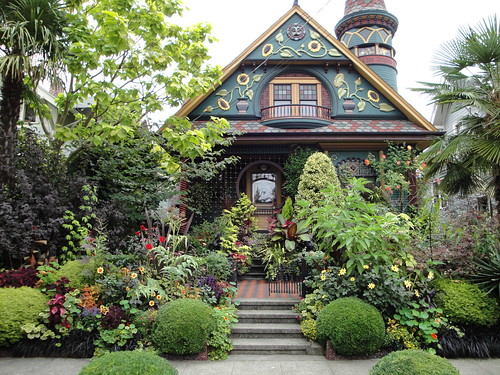
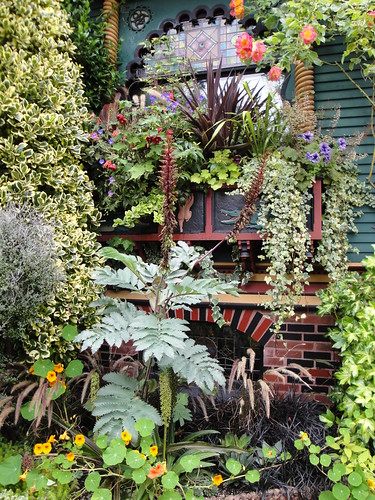
I've posted several stories about my work with Dr. Brian Coleman and his infamous house in Seattle's Queen Anne neighborhood. Come August and into September, the final push for more flowers is quite evident in the massive array of colors, forms and textures I've attempted to incorporate into a house and garden, who's motto is "The more the better!", really comes together.

Have a look:


Queen Anne Home Sept 2010

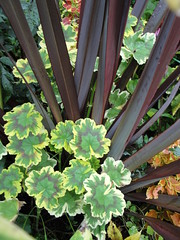
Geranium with Phormium Composition
There's something about the contrast and collaboration of these two plants that make it very effective. This is Phormium tenax purpurea with Pelargonium 'Mrs. Pollock' or Tricolor Geranium.

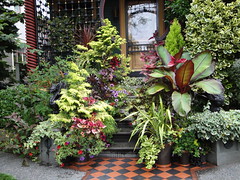
Front Steps Container Planting Composition
The front steps look amazing accented with those large Ensete bananas.

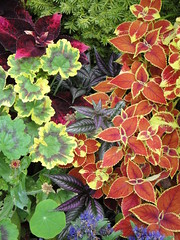
Geranium Persian Shield and Coleus Composition
OMG, talk about color!!

Windowbox and Lower Bed Composition
The windowbox and surrounding seasonal plantings were exceptional this year highlighted with a blooming Melianthus major 'Antonow's Blue'!


There's lots of work to do to keep this up and cooling temperatures that will do most of the annuals in for the season. Now, there's a subtle transition taking place to integrate more winter interests.


R